


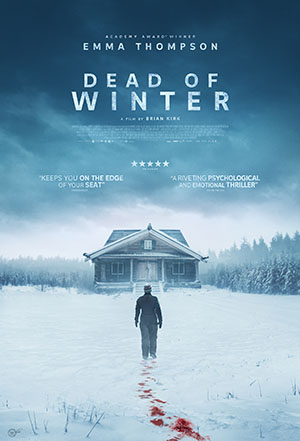
Frost-Bitten Resilience: An Analysis of Brian Kirk’s ‘Dead of Winter’ (2025)
The survival thriller has undergone a visceral evolution in Dead of Winter (2025). Directed by Brian Kirk (21 Bridges, Game of Thrones) and anchored by a transformative performance from two-time Academy Award winner Emma Thompson, the film eschews the polished artifice of modern action cinema for a gritty, grounded exploration of human endurance.
Originally announced under the title The Fisherwoman, the film transitioned to its current title to better reflect its stark, sub-zero atmosphere. Premiering at the 78th Locarno Film Festival before its theatrical release on September 26, 2025, Dead of Winter has emerged as a critical darling, praised for its subversion of gender and age tropes in the thriller genre.
Film Overview and Essential Data
| Feature | Details |
| Director | Brian Kirk |
| Lead Cast | Emma Thompson, Judy Greer, Marc Menchaca, Laurel Marsden |
| Release Date | September 26, 2025 (United States) |
| Genre | Psychological Thriller / Survival Action |
| Runtime | 98 Minutes |
| Cinematography | Christopher Ross |
| Music | Volker Bertelmann |
Narrative Synopsis: A Cold Night in Lake Hilda
The story centers on Barb (Emma Thompson), a weathered widow and retired fisherwoman from northern Minnesota. Recently bereaved, Barb embarks on a solitary pilgrimage to Lake Hilda—the site of her first date with her late husband, Karl—to scatter his ashes across the ice.
Her journey is interrupted by a catastrophic blizzard that forces her off the main road. Seeking assistance, she stops at a secluded cabin inhabited by a man known as Camo Jacket (Marc Menchaca) and his wife, Purple Lady (Judy Greer). Barb’s survival instincts flare when she notices blood in the snow and eventually witnesses a teenage girl, Leah (Laurel Marsden), attempting a desperate escape from the property.
As the storm seals off the outside world, Barb discovers a horrifying motive: the couple has kidnapped Leah to harvest her liver for an illegal transplant to save the terminally ill Purple Lady. What follows is a brutal, strategic battle of wits and willpower. Barb, armed only with her knowledge of the terrain and her husband’s old fishing gear, must protect a stranger while facing the ultimate question of what she has left to live for.
Critical Analysis: A Masterclass in Atmospheric Tension
Direction and Screenplay
Brian Kirk utilizes a disciplined directorial style that treats the Minnesota wilderness (filmed in Koli, Finland) as a primary antagonist. The screenplay by Nicholas Jacobson-Larson and Dalton Leeb is notable for its economy of dialogue. Much of the film’s weight is carried through visual storytelling, allowing the harsh environment to dictate the pace of the narrative.
Performance: The Thompson Evolution
Emma Thompson delivers what is perhaps her most physical role to date. Her portrayal of Barb is intentionally unglamorous; she is a woman defined by “Minnesota nice” resilience rather than superhuman capability. Opposite her, Judy Greer provides a chilling counterpoint. Breaking away from her comedic roots, Greer’s character is a portrait of “animal desperation,” fueled by a terminal illness and a lethal fixation on survival.
Technical Craft: Visuals and Sound
The film’s aesthetic is defined by Christopher Ross’s cinematography, which utilizes a “blue-cold” palette to emphasize the isolation of the landscape. This is punctuated by warm-hued flashbacks featuring Gaia Wise (Thompson’s real-life daughter) as a younger Barb, creating a poignant contrast between her vibrant past and her bleak present. The score by Volker Bertelmann (All Quiet on the Western Front) employs dissonant strings that mimic the sound of shifting lake ice, maintaining a baseline of auditory dread.
Strengths and Weaknesses
Strengths
-
Subversion of Tropes: By casting a woman in her sixties as a survivalist hero, the film offers a fresh perspective on the “ordinary person in extraordinary circumstances” narrative.
-
Grounded Realism: Barb’s solutions to problems—such as stitching her own wounds or using fishing tackle as a weapon—feel earned and authentic.
-
Tight Runtime: At 98 minutes, the film maintains a relentless momentum, avoiding the bloat common in contemporary thrillers.
Weaknesses
-
Flashback Pacing: While the flashbacks provide emotional context, some critics find they occasionally disrupt the tension of the present-day survival plot.
-
Supporting Character Depth: While the lead trio is exceptional, the character of the captive Leah is somewhat underwritten, serving primarily as a catalyst for Barb’s heroics.
Final Verdict
Dead of Winter (2025) is a bracing, high-stakes thriller that succeeds because of its commitment to realism and its stellar lead performances. It is a rare film that balances heart-pounding suspense with a genuine meditation on grief. For audiences seeking a mature, character-driven alternative to the standard action fare, this film is an essential watch.