


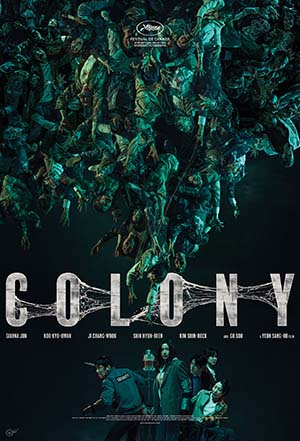
The Collective Nightmare: Yeon Sang-ho’s ‘Colony’ (2026) Reinvents the Zombie Genre Through the Lens of Hive Intelligence
Ten years after rewriting the global blueprint for the modern undead subgenre with Train to Busan (2016), South Korean auteur Yeon Sang-ho returns to his roots with Colony (2026) (Korean: 군체 / Gunche). Premiering to intense critical anticipation in the Midnight Screenings section at the Cannes Film Festival before launching its worldwide theatrical rollout, this high-concept action-horror feature signals a fascinating paradigm shift. Co-written by Yeon and his frequent collaborator Choi Gyu-seok (Hellbound), Colony trades the expansive locomotive tracks of his previous masterpieces for the suffocating, vertical isolation of a corporate research skyscraper. The result is a masterfully executed biological thriller that examines social conformity, corporate negligence, and the profound terrors of hyper-connectivity.
‘Colony’ (2026): Key Film Data
| Metric / Attribute | Film Details |
| Title | Colony (Korean: 군体 / Gunche) |
| Release Date | May 15, 2026 (Cannes Film Festival), May 21, 2026 (South Korea), June 3, 2026 (Indonesia) |
| Genre | Action Horror, Science Fiction, Biological Thriller |
| Director | Yeon Sang-ho |
| Screenwriters | Yeon Sang-ho, Choi Gyu-seok |
| Running Time | 122 minutes |
| Production Companies | Showbox, Wowpoint, Smilegate, Midnight Studio |
| Lead Cast | Jun Ji-hyun, Koo Kyo-hwan, Ji Chang-wook, Kim Shin-rok, Shin Hyun-been, Go Soo |
| MPAA / Age Rating | R / 13+ (LSF Indonesia) |
| Budget | Estimated US$ 20 million |
Full Plot Synopsis
The narrative of Colony unfolds entirely within the clinical, hyper-modern confines of a multi-tiered international biotechnology corporate headquarters. Professor Kwon Se-jeong (Jun Ji-hyun), a highly respected but recently blacklisted biotechnology academic, is reluctantly brought to a high-profile international science conference hosted at the facility by her ex-husband, Han Gyu-sung (Go Soo). Desperate to rehabilitate her career after a series of institutional fallouts, Se-jeong hopes to secure a fresh advisory role from the firm’s directors.
The event descends into absolute panic when a rogue, disgruntled former senior researcher named Seo Young-chul (Koo Kyo-hwan) orchestrates a targeted act of biological terrorism. Young-chul unleashes a highly volatile, synthetically engineered pathogen directly into the building’s ventilation system. The virus works with devastating speed, causing immediate neurological collapse, tissue mutation, and reanimation in those exposed. Recognizing the global threat of an uncontained outbreak, automated security protocols activate instantaneously, sealing every exit, emergency window, and underground terminal—trapping hundreds of high-profile attendees, researchers, and civilian staff inside a vertical tomb.
As the infected begin their assault, Se-jeong finds herself leading a fractured collective of survivors stuck on the lower commercial floors. Among them are Choi Hyun-seok (Ji Chang-wook), an iron-willed building security specialist determined to navigate the complex to rescue his vulnerable sister, Choi Hyun-hee (Kim Shin-rok), who remains isolated on an upper floor. Meanwhile, outside the impenetrable glass walls, Gong Seol-hee (Shin Hyun-been), a dedicated field researcher, works alongside emergency services in a desperate, race-against-time effort to crack the building’s systems and synthesize an antidote from external blueprints.
The traditional rules of survival horror are shattered when Se-jeong and Hyun-seok witness the unique nature of the infection, which the characters designate as Gunche (The Colony). These entities do not behave as aimless, solitary predators. Instead, they share a unified, instantaneous sensory link mediated by a rapidly blooming biological mycelium network that weaves through the building’s architecture.
When one infected asset learns a piece of information—such as how to bypass a mechanical security lock, manipulate an elevator, or circumvent a barricade—the entire horde absorbs that tactical data in real-time. Facing an adversary that possesses collective intelligence and adaptive learning capabilities, the surviving remnants must execute a brutal, floor-by-floor ascent to reach Young-chul’s primary third-floor laboratory, where the only viable vaccine prototype is locked behind bio-concentric security gates.
Detailed Critical Analysis
Themes: The Terrors of Hyper-Connectivity and Conformity
Where Train to Busan functioned as an razor-sharp critique of late-stage capitalism and class selfishness, Colony focuses its thematic crosshairs on the anxieties of modern digital societal structures. Director Yeon Sang-ho explicitly explores the horror of losing individuality to an all-consuming collective consciousness.
The Gunche serves as a visceral manifestation of online tribalism, algorithmic echo chambers, and extreme social conformity. The terror stems from the fact that minority thought or independent action is systematically systematically crushed by an overwhelming, synchronized consensus. The corporate skyscraper itself serves as a micro-cosmic laboratory for this sociological collapse, illustrating how quickly institutional structures turn on the individuals who built them.
Direction and Screenplay
Yeon Sang-ho’s direction exhibits a mature command of spatial tension, making excellent use of the film’s 122-minute runtime. By containing the narrative within the geometric, sterile lines of a corporate complex, Yeon creates a stark visual contrast between clean, corporate minimalism and the raw, fluid chaos of biological decay.
The screenplay, co-written with Choi Gyu-seok, is remarkably disciplined. It avoids the temptation of heavy-handed scientific exposition, choosing instead to let the audience deduce the escalating rules of the Gunche alongside Se-jeong. The vertical progression of the plot—ascending from the public commercial lobbies to the restricted, elite laboratory floors—subtly mirrors a rigid class hierarchy that the characters must physically and metaphorically tear through.
Performances and Character Dynamics
The performances ground the film’s high-concept science fiction mechanics in deep psychological truth.
-
Jun Ji-hyun (Gianna Jun) delivers a magnificent, transformative performance as Kwon Se-jeong. Marking a highly anticipated return to feature cinema, she strips away her past glamorous screen personas to portray a pragmatic, deeply fatigued intellectual. Her performance anchors the film, balancing tactical calculation with an underlying undercurrent of survivor’s guilt.
-
Ji Chang-wook subverts traditional action-hero expectations as Choi Hyun-seok. Rather than portraying an untouchable operative, he imbues Hyun-seok with a desperate, grounded physical exhaustion, driving the action choreography with stakes that feel distinctly human and dangerous.
-
Koo Kyo-hwan is exceptionally magnetic as the unstable antagonist Seo Young-chul. He avoids predictable, mustache-twirling villain tropes, opting instead for a quiet, nihilistic philosophical conviction that makes his erratic behavior genuinely unpredictable and terrifying.
-
Kim Shin-rok provides the emotional heartbeat of the supporting cast, capturing a raw, vulnerability that highlights the high human cost of the institutional crisis unfolding around them.
Visuals, Production Design, and Soundscapes
The aesthetic architecture of Colony is a critical component of its success. Production designer Jeon Young crafts a brilliant environment where cold glass, polished marble, and stainless steel slowly become encrusted with the fibrous, organic lattice of the mycelium outbreak.
The cinematography utilizes clinical, fixed-camera movements during the film’s opening act, which gradually devolve into erratic, claustrophobic hand-held compositions as the automated containment zones fracture.
The sound design, managed by Julien Paschal, is arguably the film’s most innovative element. Instead of relying on standard orchestral crescendos, the auditory tracks are dominated by the metallic hum of failing air filtration units, the rhythmic blare of industrial alarms, and a terrifying, low-frequency collective clicking sound that the horde uses to signal synchronized tactical movements through the building’s infrastructure.
Strengths and Weaknesses
Strengths
-
Revolutionary Monster Mythology: Introducing adaptive, AI-level swarm intelligence to the infected elevates the film far above generic survival horror fare.
-
Impeccable Pacing: The vertical layout of the tower provides a natural narrative momentum that builds tension seamlessly across all three acts.
-
Powerhouse Performances: The creative pairing of Jun Ji-hyun’s calculated composure with Koo Kyo-hwan’s volatile, psychological eccentricity creates incredible dramatic friction.
-
Exceptional Production Design: The tangible, evolving degradation of the corporate set design provides a vivid visual metaphor for structural rot.
Weaknesses
-
Underdeveloped Secondary Cast: A few supporting characters among the trapped civilians are introduced with interesting premises but are discarded too quickly to make a lasting emotional impact.
-
Familiar Structural Framework: Despite the wildly original biological mechanics of the horde, the broader narrative framework occasionally relies on classic “trapped-in-a-building” action-survival formulas.
Final Verdict
Colony is an undeniable triumph of contemporary international genre cinema. Yeon Sang-ho successfully strips away the macro-level post-apocalyptic tropes of his recent work to deliver an intimate, claustrophobic masterclass in sociological terror. Anchored by a fierce, commanding lead performance from Jun Ji-hyun and driven by an inventive reimagining of evolutionary horror, the film demonstrates that the undead genre still possesses immense thematic vitality when guided by an insightful creative vision. It stands as one of the most intellectually stimulating and intensely thrilling horror offerings of 2026