


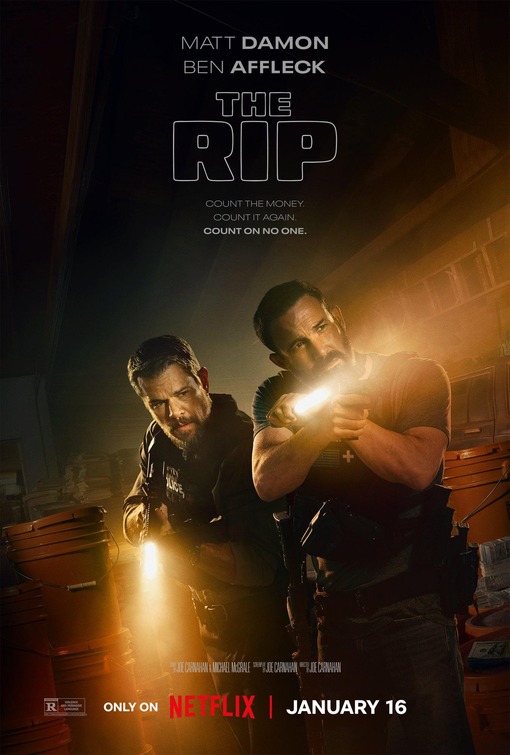
The Rip Movie Review: Affleck and Damon Reunite for a Gritty, High-Stakes Miami Crime Thriller
Genre: Crime, Thriller, Action
Director: Joe Carnahan
Cast: Matt Damon, Ben Affleck, Steven Yeun, Teyana Taylor, Kyle Chandler, Scott Adkins
Release Date: January 16, 2026 (Netflix)
Runtime: 133 Minutes
It has been nearly three decades since Matt Damon and Ben Affleck first etched their names into Hollywood history as a writing duo, and while they have shared the screen multiple times since, The Rip marks a specific, long-awaited milestone. This is the first time the pair has co-starred in a pure, hard-boiled crime thriller—a genre both have mastered individually in films like The Town and The Departed. Directed by Joe Carnahan (Narc, The Grey) and produced under the duo’s artist-led banner, Artists Equity, The Rip is a muscular, sweat-soaked homage to 1970s police procedurals.
Set against the neon-lit, humid backdrop of Miami, the film trades the polish of Ocean’s Eleven for the moral gray zones of Prince of the City. While it doesn’t entirely reinvent the “cops find money” trope, The Rip succeeds on the sheer combustible chemistry of its leads and Carnahan’s relentless, visceral direction. It is a tense examination of greed, brotherhood, and the corrosive nature of suspicion within a tactical unit pushed to its breaking point.
Plot Synopsis: Blood Money and Broken Trust
The narrative centers on a tactical narcotics unit in the Miami Police Department, led by the weary, cynical Lt. Dane Dumars (Ben Affleck) and his longtime partner and moral anchor, Det. Sgt. JD Byrne (Matt Damon). The team, which includes the volatile but skilled Detective Mike Ro (Steven Yeun) and the sharp-witted Detective Numa Baptiste (Teyana Taylor), is accustomed to the thankless grind of low-level busts and bureaucratic red tape. They are competent professionals drowning in a system that views them as disposable assets.
The status quo shatters during a raid on a derelict stash house in a neglected sector of the city. Expecting a standard seizure of narcotics, the unit instead uncovers a staggering discovery: millions of dollars in untraced cash, hidden behind a false wall. There are no drugs, no witnesses, and, initially, no paper trail.
In a split-second decision that defines the rest of the film, Dumars suggests they report only a fraction of the haul. Byrne, initially resistant, is coerced by the logic of their financial struggles and the collective resentment toward a system that has left them underpaid and overworked. They rationalize the theft as a “rip”—police slang for seizing criminal assets that won’t be missed by anyone but the cartels.
However, the euphoria of the heist is short-lived. As the unit attempts to launder and split the money, paranoia sets in. The “rip” was not as clean as they thought; the money belongs to a shadowy syndicate with reach far beyond the streets of Miami. When outside forces, including the menacingly polite DEA Agent Mateo ‘Matty’ Nix (Kyle Chandler), begin to close in, the unit’s cohesion fractures. The film spirals into a claustrophobic game of cat-and-mouse where the greatest threat isn’t the criminals outside, but the partner standing next to you.
Critique and Analysis
Themes: The Corrosive Nature of Greed
The Rip operates comfortably within the thematic wheelhouse of classic noir. The central thesis is simple: every man has a price, and every price comes with a consequence. Carnahan explores the specific socioeconomic anxieties of modern policing. Unlike the glamorized super-cops of blockbuster franchises, Dumars and Byrne are portrayed as blue-collar workers with mortgages, alimony, and debt. The cash isn’t just luxury; it represents an exit strategy from a life of violence.
The film excels in depicting how quickly the justification of “victimless crime” rots away. The script, co-written by Carnahan and Michael McGrale, meticulously dismantles the unit’s loyalty. The “brotherhood in blue” is revealed to be fragile when weighed against self-preservation. This is not a story of heroes and villains, but of desperate people making fatal errors in judgment.
Acting: A Powerhouse Reunion
The draw of The Rip is undoubtedly its headliners, and they deliver performances that leverage their real-life history.
-
Ben Affleck as Lt. Dane Dumars: Affleck channels the weary intensity he brought to The Town, but with a darker, more nihilistic edge. Dumars is the instigator, a man who believes he is owed something by the world. Affleck plays him not as a mustache-twirling villain, but as a tragic figure whose confidence blinds him to the inevitable fallout.
-
Matt Damon as Det. Sgt. JD Byrne: Damon offers a perfect counterpoint as the unit’s moral compass that slowly demagnetizes. His performance is restrained and internalized, conveying the suffocating guilt of a man who knows he has crossed a line he can never uncross. The scenes where Byrne tries to maintain a facade of normalcy while the walls close in are among the film’s best.
-
Supporting Cast: The ensemble is uniformly excellent. Steven Yeun is a standout as Mike Ro, bringing a frantic, live-wire energy that contrasts with the veterans’ stoicism. Kyle Chandler is cast against type as the antagonist Agent Nix; he is a shark in a cheap suit who smells blood in the water, delivering threats with a chillingly calm demeanor. Scott Adkins provides the requisite physical menace in the film’s action sequences, reminding audiences of his elite status in the martial arts genre.
Direction and Visuals
Joe Carnahan has always favored a gritty, kinetic aesthetic, and The Rip is no exception. Collaborating with cinematographer Juan Miguel Azpiroz, Carnahan captures Miami not as a glossy tourist destination, but as a sweating, claustrophobic urban jungle. The color palette is dominated by sickly sodium-vapor yellows, deep blacks, and the stark, harsh white of interrogation rooms.
The action sequences are grounded and brutal. There are no gravity-defying stunts here; the violence is messy, loud, and impactful. A mid-movie shootout in a crowded market is staged with terrifying confusion, emphasizing the collateral damage of the unit’s choices. Carnahan uses handheld cameras to heighten the sense of anxiety, keeping the audience as off-balance as the characters.
Screenplay and Pacing
The script is tight, clocking in at 133 minutes but feeling significantly shorter due to the relentless pacing. The dialogue is snappy and laden with police jargon, lending an air of authenticity to the proceedings. However, the film does stumble slightly in the second act, where a few plot contrivances are necessary to keep the heat on the protagonists. While the narrative arc is somewhat predictable—fans of Treasure of the Sierra Madre will recognize the beats—the execution is sharp enough to keep viewers engaged.
Technical Breakdown
| Category | Rating | Notes |
| Cinematography | 8.5/10 | Gritty, high-contrast visuals that capture the heat and humidity of Miami. |
| Score | 8/10 | Clinton Shorter’s pulsing, industrial synth score ramps up the tension effectively. |
| Editing | 9/10 | Sharp cuts and seamless transitions between quiet tension and explosive violence. |
| Action Choreography | 9/10 | Realistic, visceral combat. The tactical raids are executed with military precision. |
Strengths and Weaknesses
Strengths
-
Chemistry: The lived-in dynamic between Affleck and Damon anchors the film emotionally. You believe these men have trusted each other with their lives for decades, making their eventual conflict all the more tragic.
-
Atmosphere: The film oozes tension. The sound design, combined with the visual heat, creates a palpable sense of dread.
-
Supporting Turns: Steven Yeun and Teyana Taylor add significant depth to the ensemble, preventing the film from becoming a two-man show. Yeun, in particular, steals several scenes with his unpredictable volatility.
-
Old-School Feel: It respects the intelligence of the audience, avoiding excessive exposition in favor of visual storytelling. It feels like a throwback to the gritty crime dramas of the 70s and 90s.
Weaknesses
-
Familiar Tropes: The narrative arc—finding money, bad decisions, turning on each other—is well-trodden ground. The film doesn’t offer many new twists on the genre’s standard formula.
-
Predictability: While the execution is top-tier, the destination of the plot is somewhat inevitable from the moment the cash is found.
-
Character Depth: While the leads are well-drawn, some of the wider tactical team members feel like sketches rather than fully realized people, existing primarily to increase the body count or raise the stakes.
Final Verdict
The Rip is a triumphant return to form for the adult-oriented crime thriller. It does not seek to revolutionize the genre but rather to execute it with lethal precision. Joe Carnahan has crafted a film that feels both modern and classically rugged, bolstered by two movie stars who understand exactly what the material requires of them.
While it may not offer surprising narrative twists, the journey is so tense and the performances so compelling that the familiarity hardly matters. It is a film about the weight of choices and the terrifying speed with which a lifetime of good work can be undone by a single moment of greed. For fans of Heat, Narc, and The Town, this is essential viewing.
Rating: 4 out of 5 Stars