


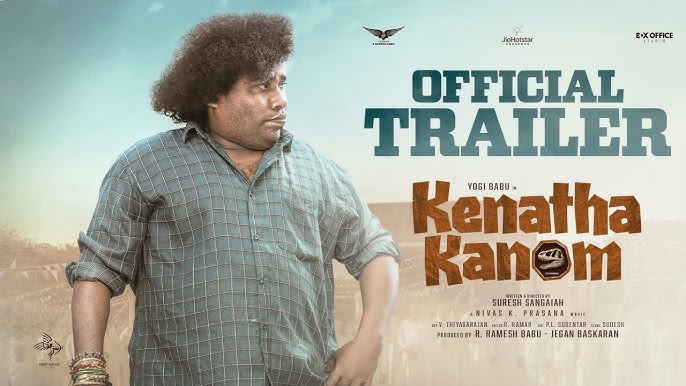
Kenatha Kanom Movie Review: A Sharp Satire on Rural Bureaucracy and Ancient Discoveries
The landscape of Tamil cinema has often found its most potent stories in the parched soil of its rural hinterlands. Kenatha Kanom (2026), the final directorial venture of the late Suresh Sangaiah, continues this tradition, blending the director’s signature deadpan humor with a socio-political premise that is as quirky as it is relevant. Starring Yogi Babu in one of his most grounded performances to date, the film explores what happens when a village’s desperate search for a basic necessity—water—unearths a relic of the prehistoric past.
Released on March 13, 2026, the film marks a posthumous release for Sangaiah, who passed away in 2024. Known for his ability to find humor in the mundane (Oru Kidayin Karunai Manu), Sangaiah uses Kenatha Kanom to bridge the gap between ancient history and modern survival, creating a narrative that is part village comedy and part bureaucratic thriller.
Kenatha Kanom (2026) Movie Overview
| Category | Details |
| Title | Kenatha Kanom |
| Release Date | March 13, 2026 |
| Genre | Comedy, Drama, Satire |
| Director | Suresh Sangaiah |
| Cast | Yogi Babu, Lovelyn Chandrasekhar, Raichal Rabecca, George Maryan |
| Runtime | 116 Minutes (1h 56m) |
| Music Director | Nivas K Prasanna |
| Language | Tamil |
Full Plot Synopsis: From Drought to Dinosaurs
Set in the drought-stricken Ramanathapuram district, Kenatha Kanom introduces us to Manivasagam (Yogi Babu), a temple sculptor and priest living a modest life with his grandfather. The village is suffocating under a severe water crisis—a shortage so dire that it dictates everything from daily chores to matrimonial alliances. Manivasagam himself is a victim of this; his marriage to Yazhini (Lovelyn Chandrasekhar) is stalled because her father refuses to marry her off to a village where women must trek miles just for a single pot of water.
In a desperate move to secure his future and help his community, Manivasagam consults a water diviner who identifies a promising spot for a well right in front of his house. He agrees to the project, hoping that a successful well will finally clear the political and social path for his wedding.
However, as the shovels strike deep, they do not hit an aquifer. Instead, they uncover the massive, fossilized remains of a 66-million-year-old dinosaur. What should be a scientific triumph quickly turns into a nightmare for the residents. A government archaeologist, Sundaravalli (Raichal Rabecca), arrives and effectively places the village under bureaucratic martial law. Declared a protected heritage site, the village faces mass eviction and laughably low compensation.
The conflict escalates when the fossil mysteriously “disappears” overnight, leading to a standoff between the state authorities and the villagers. Manivasagam, using the missing fossil as leverage, begins to negotiate not for money, but for the basic infrastructure and water rights the village has been denied for decades.
Detailed Critique: Analyzing Sangaiah’s Final Vision
Direction and Screenplay
Suresh Sangaiah remains consistent in his approach to rural storytelling. His direction is unobtrusive, allowing the natural idiosyncrasies of the village folk to take center stage. The screenplay is peppered with sharp satire, particularly regarding how the “big picture” of national heritage often tramples over the “immediate needs” of the common man. The dialogue is a highlight, specifically the deadpan reactions of villagers to scientific jargon they find utterly useless.
Performances: Yogi Babu’s Evolution
Yogi Babu anchors the film with a restrained and sincere performance. While his trademark wit is present, he avoids the slapstick tropes that often define his supporting roles. As Manivasagam, he portrays a man caught between personal desire and communal responsibility with genuine empathy.
Lovelyn Chandrasekhar delivers a feisty performance as Yazhini, representing a younger generation that is vocal about their rights and education. Raichal Rabecca is equally effective as the archaeologist; she plays the “antagonist” not as a villain, but as a rigid professional who views the world through a lens of science and policy, completely detached from the human reality of the drought.
Visuals and Sound
Cinematographer V. Thiyagarajan captures the arid landscape with such clarity that the heat feels palpable. The visuals emphasize the “dryness” of the village, making the discovery of the fossils feel even more surreal. Nivas K Prasanna’s musical score provides a necessary emotional layer, though it occasionally feels a bit more traditional than the film’s quirky premise requires.
Strengths and Weaknesses
Strengths
-
Original Premise: The collision of a rural water crisis with paleontology is a fresh and intriguing hook rarely seen in Indian cinema.
-
Social Commentary: The film raises valid questions about land ownership and whether the state’s interest in history should supersede a citizen’s right to live.
-
Ensemble Cast: The supporting characters—including George Maryan as the indifferent collector—add rich texture to the narrative.
Weaknesses
-
Pacing Issues: The middle portion drags significantly as the film transitions from the discovery to the resolution.
-
Tonal Shift: A sequence involving police brutality sits uncomfortably against the film’s otherwise lighthearted and satirical tone.
-
Logical Gaps: The climax involves a “missing” fossil that strains credibility, even within the logic of a satire.
Final Verdict
Kenatha Kanom is a bittersweet farewell to a director who understood the pulse of rural Tamil Nadu. While the execution occasionally falters under the weight of its own ambition, the film remains a thoughtful, funny, and deeply rooted piece of cinema. It treats its subjects with dignity rather than as caricatures, making it a “pleasant” but poignant watch.
Final Rating: 3.0/5 Stars