


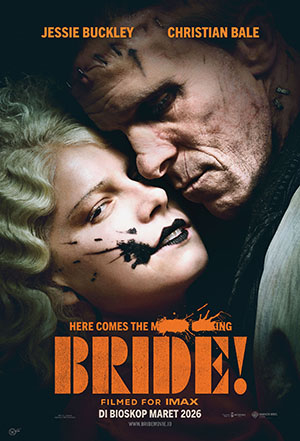
The Bride! is a 2026 American Gothic romance film written and directed by Maggie Gyllenhaal and distributed by Warner Bros. Pictures. Known for her nuanced, character-driven work, Gyllenhaal brings a fresh artistic vision to one of the most enduring stories in literary and cinematic history — the tale of Frankenstein’s bride. The film features a star-studded ensemble cast led by Jessie Buckley as the titular Bride and Christian Bale as Frankenstein’s Monster, supported by Peter Sarsgaard, Annette Bening, Jake Gyllenhaal, and Penélope Cruz. The Bride! officially premiered in London in February 2026 and debuted in U.S. theaters on March 6, 2026.
Film Overview
| Aspect | Details |
|---|---|
| Title | The Bride! |
| Genre | Gothic Romance / Horror / Period Drama |
| Director & Writer | Maggie Gyllenhaal |
| Main Cast | Jessie Buckley, Christian Bale, Peter Sarsgaard, Annette Bening, Jake Gyllenhaal, Penélope Cruz |
| Music Composer | Hildur Guðnadóttir |
| Cinematography | Lawrence Sher |
| Runtime | 126 minutes |
| Distributor | Warner Bros. Pictures |
| Release Date | March 6, 2026 |
| Country | United States |
| Language | English |
| Budget | ~$80 million |
Plot Synopsis
Set against the atmospheric backdrop of 1930s Chicago, The Bride! reimagines the Frankenstein mythos as an electrifying and emotionally charged Gothic romance. The story begins when Frankenstein’s Monster (Christian Bale) seeks companionship and persuades the visionary scientist Dr. Euphronious (Annette Bening) to help him create a partner. Together they resurrect a murdered young woman, who becomes known simply as The Bride (Jessie Buckley).
But what begins as a scientific experiment soon becomes something far more intense and unpredictable. The Bride awakens and challenges the intentions of her creators — pursuing love, autonomy, and identity in a world remade by violence, desire, and social upheaval. Amid escalating tensions, her journey intertwines with crime, passion, cultural revolt, and radical transformation that upend the lives of everyone around her.
Cast & Characters
-
Jessie Buckley — The Bride / Ida / Mary Shelley
Buckley embodies a vivid, complex incarnation of Frankenstein’s bride, combining vulnerability, ferocity, and emotional resilience. -
Christian Bale — Frank / Frankenstein’s Monster
Bale delivers a haunting portrayal of the Monster’s yearning for connection, infusing the character with dignity, anger, and depth. -
Annette Bening — Dr. Euphronious
The brilliant and morally ambiguous scientist who challenges ethical boundaries in pursuit of creation. -
Peter Sarsgaard — Detective Jake Wiles
A lawman drawn into the upheaval surrounding the Bride’s emergence. -
Jake Gyllenhaal — Ronnie Reed
A charismatic presence within the Bride’s evolving world. -
Penélope Cruz — Myrna Mallow
A complex figure whose motivations intersect with the Bride’s fate.
Supporting roles further enrich the narrative with Julianne Hough, John Magaro, Jeannie Berlin, and others seamlessly woven into the film’s multifaceted tapestry.
Direction, Themes, and Visual Style
Maggie Gyllenhaal’s Vision
Maggie Gyllenhaal’s direction strikes a bold balance between literary ambition and cinematic innovation. Building on her acclaimed debut The Lost Daughter, she expands her storytelling into Gothic romance, deftly blending horror, history, and existential inquiry. Gyllenhaal’s screenplay navigates ideas of autonomy, consent, identity, and transformation, inviting audiences to reconsider familiar mythology through a modern, emotionally provocative lens.
Genre & Atmosphere
The Bride! melds Gothic atmosphere with gritty period detail, crafting a world that feels both stylized and visceral. Set design and costume evoke the evocative streets of Depression-era Chicago, while cinematography emphasizes deep contrasts, shadows, and an almost mythic visual palette.
Critical Context & Reception
Although still fresh in its theatrical run, early reactions highlight The Bride! as a visually stunning and narratively daring reinterpretation of Frankenstein’s mythology, celebrating performance, aesthetic, and emotional complexity. Many critics have praised Jessie Buckley’s magnetic performance and Gyllenhaal’s fearless direction, positioning the film as one of 2026’s most compelling and audacious narrative adventures.
Soundtrack & Musical Identity
The film’s soundtrack — including original songs by Fever Ray — enhances its emotional landscape, marrying haunting melodies with atmospheric tension. The music contributes to the film’s ethereal yet kinetic tone, underlining key emotional beats and intensifying its Gothic romanticism.
What Makes The Bride! Stand Out
Reinventing Classic Mythology
Unlike traditional adaptations, The Bride! imbues the Frankenstein narrative with feminist, punk-inspired energy, questioning creation, autonomy, and agency in ways that feel both fresh and provocatively timeless.
Artistic Ambition
Gyllenhaal’s commitment to both character psychology and social subtext elevates the film beyond genre boundaries, blending romance, horror, and socio-political reflection into a cohesive cinematic experience.
Star Power Meets Nuanced Performance
The combination of top-tier actors and richly constructed roles ensures The Bride! resonates both emotionally and intellectually with diverse audiences.
Final Thoughts
The Bride! positions itself as a game-changing entry in contemporary genre cinema — a Gothic romance that respects its roots while forging a bold new identity. With its immersive period setting, layered characters, and visionary direction, the film is poised to leave a lasting impact on audiences and critics alike. Whether you’re drawn to the historical reinvention of classic literature or the bold evolution of cinematic storytelling, The Bride! offers a daring, unforgettable journey.
SEO Keywords & Phrases Integrated
The Bride! movie, The Bride! film review, Maggie Gyllenhaal The Bride!, Jessie Buckley Christian Bale movie, 2026 Gothic romance film, Frankenstein reimagined, The Bride! plot synopsis, The Bride! cast and characters, horror romance cinema 2026, Gothic romance movie analysis