


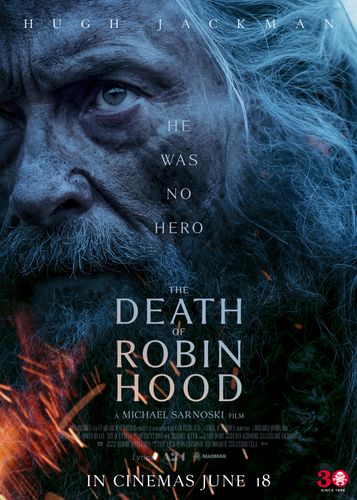
Demystifying a Folk Legend: The Death of Robin Hood (2026) Film Review
The folklore of Nottingham’s legendary outlaw has been adapted for the silver screen for over a century, ranging from the swashbuckling charm of Errol Flynn in 1938 to Ridley Scott’s gritty 2010 epic. Yet, none have stripped away the romanticism quite like writer-director Michael Sarnoski in his latest feature, The Death of Robin Hood. Released in theaters on June 19, 2026, by A24, this haunting, deconstructive thriller presents a severe, unvarnished portrait of an aging killer forced to confront the violent reality of his legacy.
Sarnoski—who proved his knack for tender, subverted character studies with Pig before stepping into studio filmmaking with A Quiet Place: Day One—returns to a hyper-focused, deeply intimate canvas. Starring Hugh Jackman as a withered, guilt-ridden Robin and Jodie Comer as a resilient prioress, The Death of Robin Hood turns the legendary hero into a broken man drowning in the blood of his past choices.
Technical Overview and Production Details
| Attribute | Details |
| Title | The Death of Robin Hood |
| Release Date | June 19, 2026 (United States) |
| Director / Writer | Michael Sarnoski |
| Lead Cast | Hugh Jackman, Jodie Comer, Bill Skarsgård, Murray Bartlett, Noah Jupe |
| Cinematographer | Pat Scola |
| Composer | Jim Ghedi |
| Runtime | 122 Minutes |
| Production Studio | Lyrical Media, Ryder Picture Company (RPC) |
| Distributor | A24 |
| Classification | Rated R (for strong bloody violence and thematic elements) |
Full Plot Synopsis: Stripping Away the Myth
Set in 1247 England, The Death of Robin Hood introduces an elderly, unkempt Robin Hood (Hugh Jackman) living in self-imposed exile deep within the brutal English wilderness. He is far removed from the pristine champion of the poor found in bedtime stories; instead, he is a feral recluse, tormented by a lifetime of theft and state-sanctioned murder. When a young woman named Wainwright (Jade Croot) tracks him down to avenge her family—whom Robin slaughtered decades prior—Robin fiercely dismisses the heroic mythology surrounding his name. He insists he was never a savior, merely a bloodthirsty outlaw. In the ensuing scuffle, Robin kills Wainwright, burying her alongside dozens of other vengeful ghosts who sought retribution before her.
Robin’s isolation is shattered by the arrival of his oldest companion, Little John (Bill Skarsgård). Now living a desperate life under the alias Edward, John begs Robin to help him reclaim his stolen farm and captive wife, Margaret, from a ruthless local family. The two aging outlaws launch a chaotic, savagely violent raid on the farmstead. While they manage to save John’s young daughter, Margaret is killed in the crossfire. During their escape, a frantic Robin shoots down a young boy named Hendrie to prevent him from alerting the local clan. Though the arrow pierces his skull, the boy survives long enough to warn his family before succumbing to his wounds.
The consequences are swift and devastating. Driven by grief and vengeance, Hendrie’s family burns Little John’s remaining land to the ground. John escapes with his daughter but leaves a mortally wounded, delirious Robin behind on a remote island.
Robin is discovered and brought to the Priory of St. Clement, where he is placed under the care of the prioress, Sister Brigid (Jodie Comer). Concealing his identity under the name Randolph, Robin enters a prolonged, feverish recovery. Within the quiet walls of the abbey, his hardened exterior begins to crack under Brigid’s empathetic, non-judgmental care. However, peace is a luxury an outlaw cannot afford. As Robin’s sins catch up to him, the sanctuary of the priory becomes a battleground for his physical survival and the ultimate fate of his soul.
Detailed Critique: Deconstruction of an Icon
Themes of Regret and the Fiction of Folklore
Sarnoski’s screenplay operates as an interrogation of how history sanitizes violence into heroism. The narrative explicitly attacks the “rob from the rich, give to the poor” ethos, characterizing it as a coping mechanism or a public rumor that Robin himself despises. The central thematic thrust explores whether a life defined by systemic slaughter can ever achieve genuine absolution. By framing Robin’s final days within a spiritual sanctuary, the film bridges the gap between historical realism and a solemn fable about the impossibility of outrunning one’s past.
Acting and Character Dynamics
Hugh Jackman delivers a towering, physically demanding performance that ranks among the finest of his career. Carrying an untamed, feral energy that evokes his work in Logan, Jackman portrays Robin with a deep-seated exhaustion. His eyes telegraph decades of unaddressed trauma, oscillating effortlessly between animalistic rage and weeping vulnerability.
Jodie Comer provides the film’s crucial emotional anchor. As Sister Brigid, she resists the urge to play a cliché archetype of angelic mercy. Comer infuses the nun with a grounded, quiet strength and sharp intellect, matching Jackman’s intensity with subtle, reactive micro-expressions. The chemistry between the two during the film’s second-act recovery arc shifts the movie from a grueling survival thriller into a poetic, deeply moving chamber piece. Bill Skarsgård’s turn as a hardened, broken Little John further underscores the tragedy, showing the bleak reality of what becomes of the “Merry Men” when the songs stop playing.
Direction and Visual Style
Michael Sarnoski establishes an uncompromising, deliberate pacing that intentionally alienates traditional action-adventure expectations. The film’s first act features sudden, shocking bursts of graphic ultraviolence that lack any cinematic glamorization. Deaths are messy, awkward, and heavy with consequence.
Cinematographer Pat Scola captures the 13th-century landscape on 35mm film, leaning heavily into natural lighting, misty mornings, and the claustrophobic interiors of stone priories. The visuals evoke a somber, tactile medieval world, utilizing a muted color palette that mirrors the protagonist’s decaying psyche.
Sound and Score
The acoustic atmosphere of The Death of Robin Hood is remarkably sparse, heavily favoring the ambient sounds of crackling fires, whistling wind, and heavy, labored breathing. The musical score by folk musician Jim Ghedi is exceptional. Ghedi employs a minimalist, doomy arrangement of period-accurate strings that occasionally erupts into haunting, traditional folkloric songs. This musical choice serves as a brilliant meta-commentary, warping the audience back into the era while undercutting the grim imagery on screen with the very melodies that romanticized Robin’s crimes.
Strengths and Weaknesses
Strengths
-
Superb Lead Performances: Jackman and Comer hold the screen with incredible dramatic gravitas, elevating a familiar archetype into something profoundly human.
-
Striking Imagery: Shot entirely on location and in studios within Northern Ireland, the film looks gorgeous, boasting an authentic, grimy medieval aesthetic.
-
Subversive Narrative Structure: By challenging the core tenets of the Robin Hood mythos, Sarnoski creates an original, thought-provoking addition to a crowded sub-genre.
Weaknesses
-
Bleak and Unrelenting Tone: The film’s unwavering commitment to misery, violence, and moral ambiguity may alienate casual viewers looking for a traditional adventure.
-
Pacing Slumps: The transition from the high-stakes violence of the first act to the static, dialogue-heavy convalescence in the priory creates a stark narrative shift that slows the momentum considerably.
Final Verdict
The Death of Robin Hood is a dark, uncompromising piece of anti-mythology that successfully dissects one of Western literature’s most enduring heroes. While its nihilistic atmosphere and deliberate pacing won’t appeal to everyone, it stands as an arresting, beautifully shot character study. Michael Sarnoski cements his reputation as a filmmaker uniquely capable of finding profound, quiet humanity beneath layers of grief and violence. Fueled by a raw performance from Hugh Jackman, this film leaves a lingering, melancholic ache long after the final frame burns out.