


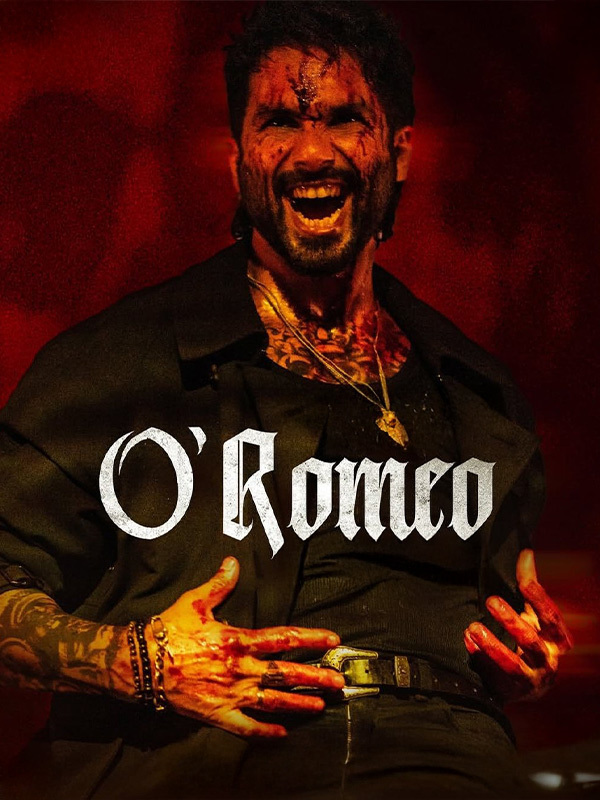
O’Romeo Review: Vishal Bhardwaj and Shahid Kapoor Return with a Feral, Operatic Underworld Saga
The cinematic marriage between director Vishal Bhardwaj and actor Shahid Kapoor has historically birthed some of Indian cinema’s most enduring modern classics. From the grittiness of Kaminey to the Shakespearean tragedy of Haider, the duo has consistently pushed the boundaries of the “dark hero” trope. Their latest collaboration, O’Romeo (2026), is no exception. Released on the eve of Valentine’s Day, this “A” rated action-thriller is far from a traditional romance. It is a blood-soaked, poetic descent into the Mumbai underworld, inspired by real events and the legendary lore of Hussain Zaidi’s Mafia Queens of Mumbai.
| Feature | Details |
| Title | O’Romeo |
| Director | Vishal Bhardwaj |
| Lead Cast | Shahid Kapoor, Triptii Dimri, Avinash Tiwary |
| Supporting Cast | Nana Patekar, Tamannaah Bhatia, Disha Patani, Farida Jalal |
| Release Date | February 13, 2026 |
| Runtime | 178 Minutes (2h 58m) |
| Genre | Action / Thriller / Crime / Romance |
| Certification | A (Adults Only) |
| Music | Vishal Bhardwaj |
| Lyrics | Gulzar |
Full Plot Synopsis: A Covenant of Blood and Love
Set against the rain-slicked, neon-shadowed streets of Mumbai, O’Romeo follows the life of Haseen Ustara (Shahid Kapoor), a lethal, razor-wielding hitman and enforcer. Ustara is a man who operates on the fringes of humanity—cold, efficient, and spiritually hollow. His life takes a sharp, jagged turn when he meets Afsha (Triptii Dimri), a mysterious and melancholic woman whose past is as scarred as Ustara’s blade.
The narrative ignites when Afsha approaches Ustara with a supari (contract) unlike any other. She doesn’t just want a rival eliminated; she wants the dismantling of a massive crime syndicate led by the formidable Ismail Khan (Nana Patekar). As Ustara accepts the contract, it becomes clear that his motivation isn’t money, but a burgeoning, obsessive passion for Afsha.
The plot thickens with the entry of Jalal (Avinash Tiwary), a fierce and volatile antagonist who serves as the dark mirror to Ustara’s calculated violence. As Ustara moves from the claustrophobic local trains of Mumbai to a massive, Spanish-inspired colosseum—a visual metaphor for the gladiatorial nature of the underworld—the film explores whether true love can survive in a heart that has long been “stone-hearted.” The forbidden romance leads to a gang war that threatens to uproot the very foundations of the city’s crime hierarchy, culminating in a tragic, Shakespearean finale where the lines between the hunter and the hunted blur permanently.
Detailed Critique: Direction, Themes, and Performances
Direction and Screenplay
Vishal Bhardwaj remains the master of the “Indian Noir.” In O’Romeo, he utilizes a screenplay co-written with Rohan Narula to weave a narrative that feels both operatic and grounded. Bhardwaj’s direction is patient, allowing the tension to simmer before exploding into visceral action sequences. The screenplay is peppered with the trademark Bhardwaj-Gulzar dialogue-baazi—lines that are sharp, rhythmic, and heavy with double meanings.
Acting: A Career-Defining Turn for the Lead Trio
Shahid Kapoor delivers what many are calling his most “feral” performance to date. If Kabir Singh was about internal rage, Ustara is about externalized, sharp-edged desperation. Kapoor’s physicality—lean, scarred, and agile—complements his ability to convey deep vulnerability through a single gaze.
Triptii Dimri, as Afsha, serves as the film’s emotional anchor. In a role that demands restraint over melodrama, she brings a “soft yet haunting” presence. She isn’t just a damsel in distress; she is the architect of the chaos, and Dimri plays that duality with chilling precision.
Avinash Tiwary (Jalal) is the revelation of the film. Learning Flamenco for the role, his movements are rhythmic yet threatening. He provides a formidable foil to Kapoor, making for one of the most memorable antagonist-protagonist dynamics in recent years.
Visuals and Sound Design
The cinematography by Ben Bernhard captures a version of Mumbai that feels alien yet familiar. The use of a muted color palette, occasionally broken by the deep red of blood or the neon glow of a bar, creates an immersive atmosphere.
The sound design is equally meticulous. From the metallic shink of Ustara’s razor to the haunting background score composed by Bhardwaj himself, the film is a sensory experience. The soundtrack, with lyrics by Gulzar, includes standouts like “Hum To Tere Hi Liye The” (sung by Arijit Singh) and the high-energy “Paan Ki Dukaan,” which add layers of emotional texture to the gritty narrative.
Strengths and Weaknesses
Strengths
-
The Reunion: The undeniable chemistry between Bhardwaj’s vision and Kapoor’s execution.
-
Atmospheric Storytelling: A masterclass in creating a sense of dread and beauty simultaneously.
-
Strong Ensemble: Nana Patekar’s understated menace and Farida Jalal’s surprising turn add significant weight.
-
Action Choreography: Raw and realistic, avoiding the “superhuman” tropes often seen in Bollywood.
Weaknesses
-
Pacing: At nearly three hours, the second act occasionally feels over-extended.
-
Logic Gaps: Some of the underworld logistics feel slightly simplified for the sake of the romantic narrative.
-
The “A” Rating: The extreme violence and dark themes may limit the film’s appeal to a general family audience.
Final Verdict
O’Romeo is a brutal, beautiful, and deeply moving piece of cinema. It is a film that refuses to offer easy answers or happy endings, choosing instead to explore the jagged edges of unrequited passion. For fans of the “Bhardwaj-verse,” it is a triumphant return to form. For Shahid Kapoor, it is another milestone in a career defined by risk-taking. It is a “baap-level” cinematic experience that balances the demands of “mass” action with the sensibilities of “class” storytelling.
Rating: 4.5/5 Stars