


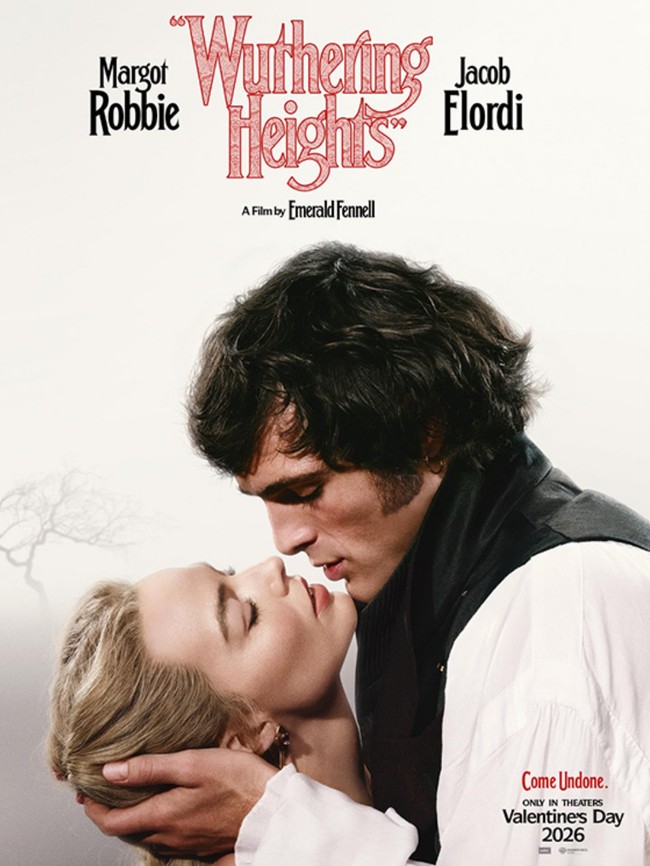
“Wuthering Heights” (2026) Review: Emerald Fennell’s Gothic Fever Dream is a Polarizing Neon-Soaked Nightmare
Emerald Fennell has never been one for subtlety. From the candy-coated vengeance of Promising Young Woman to the salt-rimmed aristocratic depravity of Saltburn, her filmography is a testament to the “more is more” philosophy of filmmaking. With her latest effort, a 2026 reimagining of Emily Brontë’s “Wuthering Heights” (the quotation marks are an essential, stylized part of the title), Fennell takes a sledgehammer to the period-drama genre.
Releasing worldwide on February 13, 2026, just in time to sour any traditional Valentine’s Day sentiment, this adaptation is less a literal translation of the 1847 novel and more a “disemboweling” of its themes. Starring Margot Robbie and Jacob Elordi, it is a film designed to be argued about, a lush, sado-masochistic odyssey that prioritizes raw feeling over historical accuracy.
Movie Overview and Essential Data
| Feature | Details |
| Release Date | February 13, 2026 |
| Director | Emerald Fennell |
| Starring | Margot Robbie, Jacob Elordi, Shazad Latif, Hong Chau |
| Genre | Gothic Romance / Drama / Thriller |
| Runtime | 2 Hours 16 Minutes |
| Cinematography | Linus Sandgren |
| Original Score | Anthony Willis (with songs by Charli XCX) |
| Studio | Warner Bros. Pictures / LuckyChap Entertainment |
Full Plot Synopsis: A Cycle of Obsession
Set against the desolate, windswept backdrop of the Yorkshire moors, the story begins with the arrival of a young, “nameless” orphan brought home by the stern Mr. Earnshaw (Martin Clunes). Named Heathcliff after a deceased son, the boy forms an immediate, feral bond with Earnshaw’s daughter, Catherine (played in youth by Charlotte Mellington). Their childhood is a blur of mud, whispers, and a shared rejection of the polite world.
The narrative fast-forwards to adulthood, where the intensity of their connection has curdled into something dangerous. Catherine Earnshaw (Margot Robbie) is now a woman of “godlike power,” as Fennell describes her—wilful, occasionally cruel, and deeply aware of the social limitations placed upon her. Heathcliff (Jacob Elordi) has grown into a brooding, physically imposing force of nature, his back scarred from childhood whippings and his heart hardened by years of abuse from Catherine’s brother, Hindley (Ewan Mitchell).
The breaking point arrives when Catherine, seeking security and status, accepts a marriage proposal from the refined Edgar Linton (Shazad Latif) of Thrushcross Grange. Overhearing a conversation where Catherine admits it would “degrade” her to marry him—but missing the part where she confesses their souls are the same—Heathcliff vanishes into the night.
He returns years later, wealthy and vengeful, to find Catherine living a gilded, hollow life with Edgar. What follows is a psychological war of attrition. Heathcliff systematically dismantles the lives of those who kept them apart, including Edgar’s sister Isabella (Alison Oliver), whom he treats with calculated indifference. The film focuses exclusively on the first half of Brontë’s novel, culminating in a hallucinatory, tragic finale that suggests death is not an end to their obsession, but its ultimate fulfillment.
Detailed Critique: The Fennell Touch
Direction and Vision
Emerald Fennell treats the Yorkshire moors not as a historical setting, but as a psychological landscape. Working again with cinematographer Linus Sandgren, she utilizes 35mm VistaVision to create images that feel tactile and overstimulated. The palette shifts from the muddy browns of the Heights to the nauseatingly bright, candle-lit opulence of the Lintons’ estate. Fennell’s direction is “primal and sexual,” leaning into the sado-masochistic undercurrents of the source material.
Performances: Robbie and Elordi
The casting of Margot Robbie and Jacob Elordi was met with significant pre-release controversy, primarily regarding Elordi’s ethnicity (Heathcliff is described as “dark-skinned” in the text). Within the film, Elordi plays Heathcliff as a “mischievous Gregory Peck” with a darker, animalistic edge. His chemistry with Robbie is undeniable, though it lacks the soulful melancholy of previous iterations, opting instead for a “lust-worthy” friction.
Robbie’s Catherine is perhaps the film’s greatest strength. She leans into the character’s “recreational sadism,” portraying a woman who uses her beauty and social standing as weapons. It is a performance of high-wire intensity that justifies Fennell’s claim that this Cathy is “a woman who could commit a killing spree and nobody would mind.”
Visuals and Sound
The technical craft is impeccable. From Jacqueline Durran’s costumes—which include stylized, anachronistic touches like red latex and “Wuthering Heights waves”—to the haunting score by Anthony Willis. The inclusion of original songs by Charli XCX, specifically the lead single “House,” adds a modern, “club-night” energy to the gothic dread, bridge-gapping the 19th and 21st centuries.
Strengths and Weaknesses
Strengths
-
Bold Aesthetic: A visually stunning departure from the “drab” period piece tropes.
-
Lead Chemistry: Robbie and Elordi sizzle on screen, making the toxic obsession believable.
-
Fearless Tone: Fennell doesn’t shy away from the ugliness of the characters.
-
Production Design: The contrast between the two houses is masterfully executed by Suzie Davies.
Weaknesses
-
Historical Inaccuracy: Purists will likely bristle at the anachronisms and casting choices.
-
Emotional Depth: By focusing so heavily on the erotic and the “trashy soap-opera” elements, some of the novel’s spiritual weight is lost.
-
Pacing: The decision to cut the second half of the book makes the ending feel abrupt for those expecting the full generational saga.
Final Verdict
“Wuthering Heights” (2026) is not an adaptation for the faint of heart or the literary purist. It is a loud, sweaty, and deeply provocative “adaptation of a feeling.” Emerald Fennell has taken a classic of English literature and transformed it into a modern fever dream about the destructive power of desire. While it may be “emotionally hollow” for some, it is a technical triumph and a “god-tier” spectacle for those who enjoy their romance with a side of madness.
“It is an adaptation of a feeling: my first disemboweling by the baby god.” — Emerald Fennell