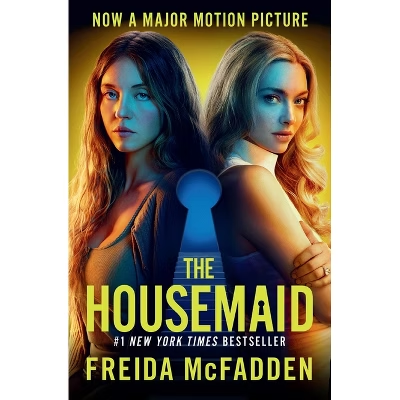
The Housemaid – Movie Synopsis
The Housemaid is a psychological thriller film that adapts the bestselling novel of the same name, translating its tense, twist-driven narrative into a dark domestic drama about class, control, and hidden violence. Set almost entirely within the confines of an elegant but unsettling suburban mansion, the film unfolds as a slow-burning descent into manipulation and moral ambiguity, where appearances are carefully curated and truth is deliberately obscured.
A Desperate New Beginning
The story centers on Millie, a young woman struggling to rebuild her life after a series of personal and legal setbacks. With no stable home, limited job prospects, and a past she is determined to keep buried, Millie accepts a live-in housekeeping position at the lavish estate of the wealthy Winchester family. The opportunity seems too good to be true: room and board, steady pay, and a chance at reinvention.
From the moment Millie arrives, however, subtle warning signs emerge. The house itself feels less like a sanctuary and more like a gilded cage. Doors lock from the outside, rooms feel oppressively quiet, and certain spaces are explicitly off-limits. Still, Millie convinces herself that unease is a small price to pay for stability.
The Winchesters’ Perfect Façade
At the heart of the household is Nina Winchester, the elegant and volatile woman who employs Millie. Nina presents herself as a high-society wife with impeccable taste and erratic moods. One moment she is charming and generous; the next she is cruel, paranoid, and emotionally abusive. Her behavior keeps Millie constantly off balance, forcing her to walk on eggshells to keep her job.
Nina’s husband, Andrew, appears to be her opposite—calm, attractive, and quietly sympathetic. He offers Millie kindness and understanding, subtly positioning himself as her protector within the house. Their conversations suggest that Nina’s instability hides a darker truth about the marriage, and Millie begins to feel she may be witnessing a woman unravel under the pressure of wealth and isolation.
Life in the Attic
Millie’s living quarters are located in a sparse attic room at the top of the house, accessible only through a narrow staircase. The room locks from the outside, a detail explained away as a safety feature but one that quickly becomes symbolic of Millie’s lack of power. At night, she hears strange noises echoing through the walls—footsteps, muffled voices, and unexplained sounds that suggest secrets hidden in the house’s architecture itself.
As Millie settles into her duties, she discovers inconsistencies in Nina’s stories and unexplained signs of violence: bloodstains that shouldn’t be there, broken objects hastily replaced, and medication taken in alarming quantities. The house begins to feel like a stage where everyone is performing a role, and Millie cannot tell which emotions are real.
Shifting Power Dynamics
What initially appears to be a story about a troubled employer gradually transforms into something far more sinister. Millie starts to realize that Nina’s behavior may not be madness but strategy. Acts of cruelty feel calculated, designed to provoke, intimidate, and control. Meanwhile, Andrew’s apparent kindness begins to feel rehearsed, his sympathy carefully timed to deepen Millie’s emotional dependence.
As Millie becomes more entangled in the Winchesters’ private lives, the power dynamics shift. She gains access to confidential information, overhears conversations not meant for her, and begins to understand that her employers may be far more dangerous than they appear. The line between victim and manipulator grows increasingly blurred.
The Weight of the Past
Interwoven with the present-day tension are revelations about Millie’s past. Flashbacks and confessions reveal that she is not simply an innocent bystander but someone who has survived — and committed — acts she would rather forget. Her need for redemption clashes with her instinct for survival, forcing her to make morally fraught decisions as the situation escalates.
These revelations reframe earlier scenes, casting Millie not as a passive victim but as a woman capable of calculated deception. The film steadily dismantles the audience’s assumptions, suggesting that everyone in the house is hiding something—and that some secrets are worth killing for.
A House of Lies
The narrative accelerates toward a series of shocking twists that expose the true nature of the Winchesters’ marriage. What seemed like emotional abuse reveals deeper layers of psychological warfare, gaslighting, and physical danger. The house itself becomes a weapon, its locked rooms and narrow corridors facilitating surveillance, confinement, and control.
Millie ultimately uncovers the truth behind Nina’s behavior and Andrew’s charm, realizing that the story she has been told is a carefully constructed lie. The supposed victim and villain swap places in a brutal reversal, forcing Millie to choose between escape and confrontation.
Survival and Reckoning
In its final act, The Housemaid transforms into a tense battle of wills. Millie must outthink and outmaneuver her employers, using the very assumptions they have made about her vulnerability against them. The climax is both violent and psychologically charged, emphasizing that survival in this house requires ruthlessness as much as courage.
The ending leaves a lingering sense of unease rather than clean resolution. While justice is partially served, the film resists simple moral closure. Millie may escape the house, but the experience reshapes her identity, reinforcing the idea that trauma does not disappear—it evolves.
Themes and Tone
At its core, The Housemaid is a story about power disguised as privilege. It examines how wealth can insulate cruelty, how domestic spaces can become sites of oppression, and how women are often pitted against one another within patriarchal structures. The film’s claustrophobic setting, restrained pacing, and emphasis on psychological tension create an atmosphere of constant dread.
Rather than relying solely on shock, the film builds suspense through implication and character psychology. Every smile feels suspicious, every locked door meaningful. By the time the truth emerges, the audience is forced to confront how easily narratives of innocence and guilt can be manipulated.
The Housemaid stands as a chilling domestic thriller that turns everyday luxury into a nightmare, reminding viewers that the most dangerous prisons are often the ones disguised as homes.