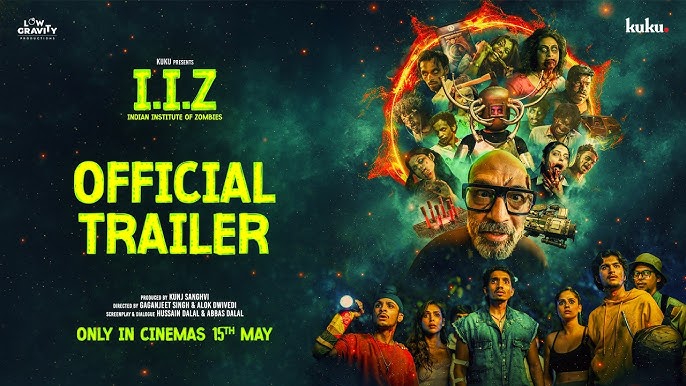
Indian Institute of Zombies (2026) Movie Review: A Campus Satire That Fails to Fully Bite
The convergence of horror and comedy—affectionately termed the “zom-com”—has undergone a massive global renaissance, but it remains a notoriously difficult subgenre to execute within Indian cinema. Balancing legitimate tension with sharp societal wit requires a steady hand.
Directed by Alok Kumar Dwivedi and Gaganjeet Singh, IIZ: Indian Institute of Zombies (2026) attempts to position itself as a spiritual successor to classic Indian student satires, mapping the existential dread of a high-pressure engineering college onto a literal zombie apocalypse. Released in theaters on May 15, 2026, the 137-minute Hindi film brings a novel, subversively funny premise to the table but ultimately stumbles down the stretch due to erratic pacing, fragmented scripting, and low-budget technical limitations.
Technical Overview and Cast Data
Before diving into the narrative architecture, an examination of the film’s foundational baseline details underscores the mid-budget, ensemble nature of this cinematic experiment.
| Metadata Metric | Film Specifications |
| Title | IIZ: Indian Institute of Zombies |
| Release Date | May 15, 2026 |
| Language / Industry | Hindi / Bollywood |
| Runtime | 137 minutes (2 hours, 17 minutes) |
| Censor Certification | A (Adults Only) |
| Directors | Alok Kumar Dwivedi, Gaganjeet Singh |
| Screenplay Writers | Hussain Dalal, Abbas Dalal, Kunj Sanghvi, Siddharth Kumar |
| Primary Cast | Anupriya Goenka, Mohan Kapur, Ranjan Raj, Jessy Lever, Rose Sardana |
Full Plot Synopsis
The story unfolds within the claustrophobic, ultra-competitive ecosystem of the Indian Institute of Innovation (a clear, thinly veiled parody of hyper-prestigious Indian engineering institutes). The student body is rigidly stratified between the hyper-intellectual “toppers”—who dominate the academic landscape—and the perennial backbenchers, stoners, and louts who merely coast by to avoid expulsion.
The inciting incident arrives during the college’s flagship festival, Tekfest 2026. An eccentric, dictatorial, and explicitly malevolent scientist, Dr. Darwendra (Mohan Kapur), arrives to demonstrate a radical biochemical innovation. He surreptitiously treats the attendees to a glowing elixir billed as a superhuman serum designed to eliminate fatigue and grant cognitive immortality. Unbeknownst to the eager engineering scholars, the serum carries a horrific side effect: it strips away free will, turning the consumer into a flesh-craving, staggering zombie.
Predictably, the first individuals to consume the potion are the overachieving toppers, who are characteristically desperate to secure any competitive advantage. As the contagion spreads exponentially, the entire elite cadre of the university transforms into the undead. Ironically, the campus’s academic outcasts choose to skip Tekfest entirely to loiter elsewhere, rendering them the only uninfected humans left alive.
When Dr. Darwendra reveals his ultimate grand plan—to weaponize the zombified students, infect the campus water supply, and systematically spread the pathogen to the surrounding city—the remaining stragglers must unite. Led by the sharp-witted Professor Breganza (Anupriya Goenka), this unlikely resistance force features:
-
The slackers Rambo (Sachin Kavetham) and Haggu (Tanishq Chaudhary),
-
The romantically preoccupied couple Bhim (Jessy Lever) and Kiran (Rose Sardana),
-
An ultra-nerd nicknamed “Kitaab” Shivdasani (Ranjan Raj), who possesses a prototype chemical antidote.
The ragtag alliance is forced to utilize unorthodox campus-centric tactics to outmaneuver the horde. They weaponize academic triggers to stall the undead, relying on surprise quizzes with minor grade weightage, impromptu dance distractions, and bureaucratic attendance sheets to disrupt the base programming of the zombie-toppers. The plot progresses as a chaotic game of survival as the group attempts to isolate Dr. Darwendra before the local police force—symbolized by the hopelessly late Inspector Reddy (Shantanu Anam)—bungles the exterior quarantine.
Detailed Critique
Themes and Satirical Subtext
The primary redeeming quality of Indian Institute of Zombies is its thematic framework. The screenplay uses the physical horror of zombification as an explicit metaphor for the institutionalized dehumanization of the Indian academic rat race. By showing that the “toppers” are effortlessly conditioned into compliant, unthinking monsters who obsess over a 2.5% exam weightage even while rotting, the directors deliver a sharp critique of an education system that prioritizes rote compliance over genuine critical thinking. The backbenchers, traditionally dismissed as academic failures, emerge as the heroes precisely because their non-conformity has preserved their humanity and resourcefulness.
Direction and Structural Pacing
Where the film severely falters is under the joint direction of Alok Kumar Dwivedi and Gaganjeet Singh. The narrative architecture feels less like a cohesive, three-act feature film and more like a collection of disparate sketch-comedy routines stitched together over a loose framework.
The 137-minute runtime is aggressively felt; scenes routinely drag beyond their logical conclusion, and secondary subplots stall out without satisfactory resolution. The directors struggle to modulate the tonal shifts between genuine claustrophobic survival horror and slapstick campus comedy, causing the tension to dissipate entirely during key survival sequences.
   [High-Concept Premise] ---> [Sharp Academic Satire]
             |
             v (Undermined by)
   [Erratic Screenplay Pacing] + [Inconsistent Zombie Logic]
Screenplay and Dialogue
The writing team, anchored by experienced industry mainstays Hussain Dalal and Abbas Dalal, delivers a script that is deeply uneven. The dialogue is dense with modern pop-culture references and hyper-localized student lingo that lands perfectly for younger, campus-centric demographics. However, for every genuinely hilarious line or clever situational gag, there are an equal number of comedic beats that miss the mark entirely.
The logic governing the zombies themselves is frustratingly fluid; the infected toggle inexplicably between mindless, ravenous aggression and highly articulate, docile obedience based entirely on whatever the immediate joke requires.
Acting and Performance Analysis
The ensemble cast anchors the film through sheer charisma, frequently elevating weak writing.
-
Anupriya Goenka commands the screen as Professor Breganza, delivering a performance grounded in equal parts authority, exasperation, and sharp comic timing.
-
Mohan Kapur leans entirely into a theatrical, campy villainy as Dr. Darwendra, clearly enjoying his role as a classic mad scientist archetype.
-
Ranjan Raj turns in a reliably empathetic performance as the tech-nerd archetype, drawing heavily on his established screen persona to provide the film’s structural exposition.
-
The trio of Sachin Kavetham, Tanishq Chaudhary, and Jessy Lever showcase exceptional comedic chemistry, accurately capturing the loose, rhythmically chaotic banter of genuine college backbenchers.
Visual Craft and Sound Design
On a technical level, the film is noticeably hindered by its restrictive production budget. The cinematography is functional but unremarkable, failing to make creative use of the stark, concrete architecture of the engineering campus to evoke genuine dread.
The visual effects and computer-generated imagery (CGI) are noticeably weak, featuring flat lighting and artificial digital enhancements that break immersion. Furthermore, the practical zombie makeup is heavily inconsistent; background actors frequently look like they belong in a low-cost haunted house attraction rather than a wide-theatrical release.
Conversely, the sound design and music are highly energetic, featuring an incredibly clever, high-vibe remix of the classic track “Maar Daala” during a crucial, crackpot distraction sequence that serves as an isolated highlight of production inspiration.
Strengths and Weaknesses
Strengths
-
Original Satirical Premise: Flipping the traditional hierarchy of an engineering college by making backbenchers the saviors against zombie toppers is an exceptionally clever narrative hook.
-
Charismatic Cast Chemistry: The young ensemble cast performs with genuine earnestness and successfully replicates authentic student dynamics.
-
Inspired Standalone Sequences: Select comedic set-pieces—specifically the deployment of surprise quizzes and administrative red tape to confuse the zombies—are brilliantly executed.
Weaknesses
-
Bloated Runtime and Pacing: At 137 minutes, the film suffers from severe structural drag and would have benefited immensely from tighter editing.
-
Subpar Production Values: The poorly executed CGI and inconsistent practical makeup effects constantly detract from the stakes.
-
Tonal Inconsistency: The screenplay frequently sacrifices survival tension and internal logic to force cheap, fleeting comedic gags.
Final Verdict
IIZ: Indian Institute of Zombies is an undeniably ambitious but fundamentally flawed entry into India’s growing stable of horror-comedies. It functions beautifully as an inside joke for engineering students and college demographics, packed with localized campus humor that will undoubtedly find a comfortable second life streaming on personal laptops across dorm rooms nationwide.
However, as a holistic piece of theatrical cinema, its technical shortcomings and undisciplined pacing prevent it from achieving the crossover success of genre highlights like Stree or Go Goa Gone. It remains a moderately entertaining, highly specific curiosity that is best approached as a casual, undemanding watch.
Final Rating: 2.0 / 5 Stars