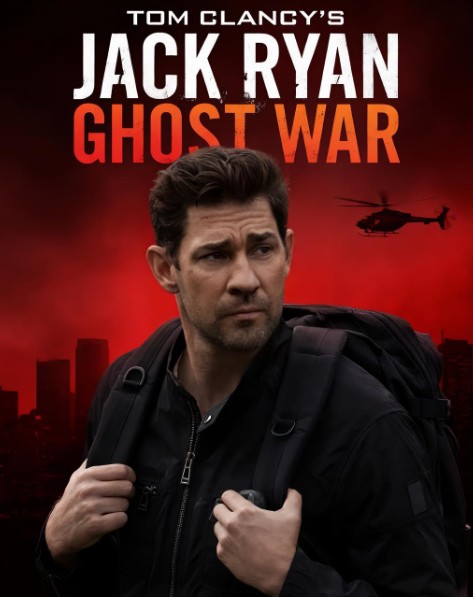
Tom Clancy’s Jack Ryan: Ghost War (2026) Review — John Krasinski Reclaims the Tech-Thriller Throne
The modern landscape of cinematic espionage has undergone a dramatic transformation. Where theatrical blockbusters once dominated, streaming ecosystems have proven that complex, long-form political machinations can thrive with a dedicated audience. Following the successful four-season run of its flagship television series, Amazon MGM Studios—in tandem with Paramount Pictures and Skydance Media—has graduated its iteration of the definitive Tom Clancy hero to the feature-film format.
Directed by seasoned franchise veteran Andrew Bernstein and co-scripted by Aaron Rabin alongside star-producer John Krasinski, Tom Clancy’s Jack Ryan: Ghost War (2026) is a tightly wound, R-rated political action thriller. It serves as both an expansion of the established streaming universe and a standalone cinematic pivot. Clocking in at an economical 105 minutes, the film seeks to balance the cerebral, data-driven methodology of Clancy’s classic literary protagonist with the muscular, high-stakes kineticism demanded by modern action audiences.
Movie Overview & Production Details
| Movie Attribute | Movie Metadata Details |
| Title | Tom Clancy’s Jack Ryan: Ghost War |
| Release Date | May 20, 2026 |
| Director | Andrew Bernstein |
| Screenplay Writers | Aaron Rabin, John Krasinski |
| Story By | Noah Oppenheim, John Krasinski |
| Based On | Characters created by Tom Clancy |
| Running Time | 105 Minutes (1 Hour, 45 Minutes) |
| MPAA Rating | R (for intense sequences of violence and language) |
| Primary Cast | John Krasinski, Wendell Pierce, Michael Kelly, Sienna Miller, Betty Gabriel |
| Production Companies | Paramount Pictures, Skydance Media, Sunday Night Productions |
| Distributor | Amazon MGM Studios (via Prime Video) |
Full Plot Synopsis
The narrative of Ghost War ignites with a sequence of systemic anomalies. Dr. Jack Ryan (John Krasinski), attempting to transition into a more stable, analytical consulting role following his turbulent tenure as CIA Deputy Director, flags a series of highly sophisticated, untraceable international bank transfers. The financial breadcrumbs do not align with state-sponsored cyber warfare or typical cartel laundering networks. Instead, they point to a localized, hyper-efficient shadow network operating within the blind spots of Western intelligence.
When a deniable covert operation in Eastern Europe unravels in disastrous fashion, Ryan is reluctantly pulled back into active field duty by CIA Director Elizabeth Wright (Betty Gabriel). The failed operation exposes a deeply unsettling truth: a rogue black-ops organization composed of former intelligence operatives, colloquially dubbed the “Ghost Unit,” is operating globally with impunity. This syndicate possesses deep knowledge of Langley’s defensive protocols, allowing them to anticipate the agency’s every countermeasure.
To intercept this escalating threat before a coordinated strike targets Western allies, Ryan reunites with his most trusted inner circle: the battle-tested, pragmatic James Greer (Wendell Pierce) and Mike November (Michael Kelly), the fiercely cynical former station chief turned private security contractor.
The investigation quickly transforms into a breathless game of cat-and-mouse across global hubs, stretching from the architectural corridors of London to the high-stakes financial centers of Dubai. The team learns that the rogue unit has acquired specialized access codes capable of blinding regional missile defense grids. Recognizing that traditional American intelligence channels are compromised from within, Ryan forms a tense, tactical alliance with Emma Marlowe (Sienna Miller), a razor-sharp MI6 officer who has been tracking the same splinter cell under a different moniker.
As the Ghost Unit orchestrates a series of devastating decoy strikes, Ryan, Greer, November, and Marlowe are forced to operate completely off the grid. They navigate betrayal from unexpected bureaucratic corners, leading to a frantic, real-time climax in an isolated logistical hub where the line between institutional duty and personal survival disappears entirely.
Detailed Film Critique
Themes and Geopolitical Resonance
At its core, Ghost War interrogates the terrifying concept of institutional drift. Unlike Cold War-era spy fiction, which drew clear, ideological boundaries between East and West, this screenplay examines the dangers of privatization and the radicalization of state assets. The villainous architecture is not an external rogue nation, but a mirror image of the protagonists themselves—ex-operatives who have decoupled from constitutional oversight. Bernstein’s film functions as anxiously relevant commentary on digital sovereignty, weaponized data, and the vulnerability of the automated systems designed to keep the peace.
Acting and Character Dynamics
John Krasinski commands the screen with an effortlessly grounded gravity. He balances the character’s hallmark analytical intellect with a weary, physical vulnerability that makes every footchase and close-quarters struggle feel genuinely perilous.
The shorthand chemistry between Pierce’s stoic, authoritative Greer and Kelly’s loose-cannon, sardonic November remains the narrative’s emotional anchor. Their presence ensures the film retains the connective tissue of the television series while stepping up to widescreen stakes.
As Emma Marlowe, Sienna Miller is an exceptional addition to the ensemble. Avoiding the standard tropes of the auxiliary European ally, her performance introduces an icy, calculated pragmatism that challenges Ryan’s more idealistic methodology, establishing Marlowe as a genuine intellectual equal rather than a secondary sidekick.
Direction and Visual Aesthetic
Andrew Bernstein maximizes the cinematic real estate afforded by a feature-film budget. Collaborating with cinematographer Arnau Valls Colomer, Bernstein trades the flat lighting schemas often found in television for a high-contrast, anamorphic visual palette. The film employs a muted color spectrum—steely blues, architectural grays, and harsh desert golds—that emphasizes the cold isolation of global espionage. The action choreography is deliberately tactile and legible; the camera stays wide enough to capture geography and stakes during gunfights, favoring practical stunts over disorienting rapid-fire editing.
Score and Sound Design
The auditory landscape, shaped by composers Ramin Djawadi and William Marriott, replaces bombastic orchestral swells with a driving, industrial synth score. The sound design treats servers, terminal keystrokes, and suppressed gunfire with equal acoustic weight, creating a pervasive sense of digital claustrophobia that aligns perfectly with the film’s title.
Critical Strengths and Weaknesses
Strengths
-
Pacing and Runtime Efficiency: In an era where blockbusters frequently suffer from bloated, self-indulgent runtimes, the 105-minute framework of Ghost War ensures the narrative rarely sags, sustaining tension from its opening breach to the final frame.
-
Tactile Action Sequences: The hand-to-hand combat and tactical shootouts are executed with realistic geometry, emphasizing cover, ammunition management, and situational awareness over superheroic invulnerability.
-
Ensemble Chemistry: The pre-existing history between Krasinski, Pierce, and Kelly allows the movie to skip tedious exposition, delivering earned camaraderie and convincing professional friction instantly.
Weaknesses
-
Familiar Antagonist Motivations: While the “rogue black-ops unit” premise provides an excellent mirror for Jack Ryan’s morality, the ultimate motivations of the primary conspirators tread highly familiar genre ground, echoing elements previously explored in the Mission: Impossible and Jason Bourne franchises.
-
Secondary Cast Underutilization: Highly capable performers like Betty Gabriel are occasionally relegated to exposition-heavy bunker scenes, monitoring radar screens and delivering tactical readouts rather than engaging directly with the central dramatic engine.
Final Verdict
Tom Clancy’s Jack Ryan: Ghost War represents a highly successful evolution for the property. By shedding the narrative padding inherent to serialized television, director Andrew Bernstein delivers an exceptionally focused, intelligent, and fiercely kinetic political thriller. John Krasinski solidifies his status as one of the definitive cinematic translations of Tom Clancy’s legendary analyst, imbuing the role with a compelling mixture of cerebral grit and physical weariness. For audiences seeking a sharp, expertly constructed espionage film that honors the legacy of its source material while embracing the demands of contemporary action cinema, Ghost War stands out as a premier entry in the 2026 thriller landscape.