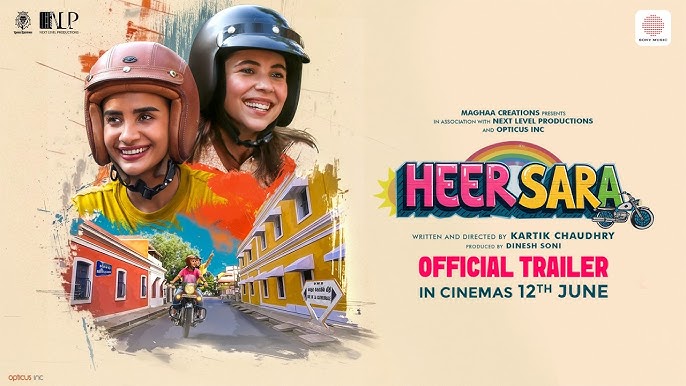
Heer Sara Movie Review: A Comedic Yet Uneven Female-Led Road Trip Odyssey
The female-led road trip subgenre has long served as fertile ground for cinematic self-discovery. Directed and written by Kartik Chaudhry, Heer Sara (2026) aims to inject contemporary Indian independent cinema with a dose of rebellion, sisterhood, and eco-conscious living. Initially titled Heer Sara Aur Pondicherry, the film generated significant pre-release conversation following a Central Board of Film Certification (CBFC) directive that mandated the excision of the Union Territory’s name from its title.
Clocking in at a brisk 99 minutes, the film marks a distinct change of pace for Hindi cinema, pairing the grounded vulnerabilities of Patralekhaa with the comedic timing of Maanvi Gagroo. While the production aspires to the heights of modern buddy dramas, the final product emerges as a sweet, aesthetically pleasing, but ultimately safe excursion that prioritizes lighthearted warmth over genuine dramatic stakes.
Technical Specifications and Production Overview
To understand the scope of the film, the fundamental production data outlines its position within the mid-budget, content-driven landscape of 2026 Hindi cinema.
| Attribute | Details |
| Director / Writer | Kartik Chaudhry |
| Lead Cast | Patralekhaa, Maanvi Gagroo |
| Supporting Cast | Shveta Salve, Arif Zakaria, Nishank Verma |
| Runtime | 99 minutes (1 hour, 39 minutes) |
| Genre | Adventure, Comedy, Drama |
| Censor Rating | ‘A’ (Adult) — Modified by CBFC |
| Release Date | June 12, 2026 |
| Language | Hindi |
Detailed Plot Synopsis
The narrative core of Heer Sara rests upon an accidental partnership formed between two profoundly contrasting women, each running toward an unresolved emotional crisis. The journey initiates in Indore, Madhya Pradesh.
Sara (Patralekhaa) is introverted, deeply melancholic, and emotionally unanchored. Haunted by the abrupt disappearance of her mother years prior, she uncovers a tenuous clue pointing toward Puducherry (formerly Pondicherry). Driven by a desperate need for closure, she opts to make the cross-country voyage on a motorcycle, seeking a physical and psychological escape from her static life.
Heer (Maanvi Gagroo), by contrast, is a tempestuous, fast-talking rebel whose chaotic energy masks deep-seated anxieties regarding abandonment and societal conformity. Heer’s immediate crisis is romantic and reactive: she has discovered a hidden truth regarding her boyfriend’s impending wedding. Determined to confront him, disrupt the ceremony, and uncover the full story, she intersects with Sara.
Lacking alternative transportation and united by a shared, albeit misaligned, direction, the two embark on a multi-state motorcycle journey.
[Indore: The Crisis] ──> [The Shared Highway] ──> [Puducherry: The Resolution]
   - Sara: Lost Mother       - Clash of Energies      - Confronting the Wedding
   - Heer: Wedding Secret    - Shared Vulnerability    - The Unresolved Past
As the geography shifts from Central India toward the coastal south, the episodic structure of the film unfolds. The duo encounters a string of minor comedic setbacks, ranging from mechanical breakdowns on isolated highways to bizarre interactions with local eccentric characters.
Throughout these skirmishes, the initial friction between Heer’s loud defense mechanisms and Sara’s insular grief begins to erode. They find common ground in shared vulnerabilities regarding parental expectations, the fragility of modern romance, and the quest for authentic self-worth. By the time the coastal winds of Puducherry arrive, the destination shifts from a pursuit of external answers to an internal reclamation of personal freedom.
In-Depth Critical Analysis
Themes: Sisterhood and the Modern Road Movie
At its most effective, Heer Sara operates as an exploration of transactional versus unconditional relationships. Director Kartik Chaudhry utilizes the open highway as a clean slate where traditional societal roles are suspended. The screenplay touches upon themes of eco-conscious living and maternal loss, attempting to ground the characters’ eccentricities in real-world mindfulness.
However, the thematic transition from individual existential crises to generalized female solidarity occasionally feels hurried, relying on montage sequences where sharp dialogue would have been more potent.
Acting and Character Dynamics
The saving grace of the feature is the palpable chemistry between its two leads.
-
Maanvi Gagroo injects Heer with a nervous, kinetic vitality that prevents the character from becoming an insufferable archetype of the “manic pixie” variant. Her performance manages to anchor the film’s comedic baseline, using physical comedy and rapid-fire delivery to mask the character’s underlying fear of rejection.
-
Patralekhaa provides a crucial, minimalist counterweight. Her depiction of Sara is quiet, heavy with unspoken grief, and physically restrained.
The moments where the two actors simply sit in silence against the landscape outshine the heavily scripted comedic set-pieces. The supporting ensemble, including Arif Zakaria and Shveta Salve, are utilized sparingly, serving more as narrative signposts than fully realized human obstacles.
Direction and Screenplay
Kartik Chaudhry exhibits a keen eye for framing personal growth against changing vistas, but his screenplay suffers from a lack of genuine danger. For a road trip film clocking under 100 minutes, the pacing is remarkably brisk, yet the narrative transitions feel overly smooth. The existential dread that typically drives individuals to radical cross-country motorcycle trips is frequently sanitized for broader consumer palatability.
The dialogue balances modern conversational Hindi with poignant introspective moments, though it occasionally succumbs to predictable, textbook self-help aphorisms in the third act.
Visual and Audio Landscape
Visually, the film is an absolute triumph of landscape cinematography. The transition from the dusty, sun-baked textures of Madhya Pradesh to the lush green corridors of the Deccan, culminating in the distinct French-colonial architecture and pastel hues of Puducherry, is rendered with vibrant clarity. The camera captures the kinetic motion of the motorcycle with a sense of liberation that mirrors the internal arcs of the protagonists.
The auditory landscape complements this visual journey with an indie-folk inflected soundtrack that avoids the over-produced bombast typical of mainstream Hindi commercial cinema, leaning instead into acoustic themes that emphasize isolation and eventual harmony.
Strengths and Weaknesses
Strengths
-
Lead Performances: The dual anchoring by Patralekhaa and Maanvi Gagroo provides a compelling study in performance contrasts.
-
Cinematography: Exceptional visual mapping of the journey that serves as a subtle narrative device for emotional transition.
-
Runtime Efficiency: At 99 minutes, the film rejects unnecessary subplots or bloating, maintaining a lean narrative trajectory.
-
Subtle Social Commentary: Seamlessly integrates contemporary ideas of female independence without transforming into an overt sermon.
Weaknesses
-
Sanitized Stakes: The journey lacks true atmospheric peril, structural conflict, or profound logistical risk, lowering the dramatic tension.
-
Abrupt Censorship Artifacts: The enforced absence of the word “Pondicherry” from the dialogue and framing occasionally creates noticeable narrative clunkiness.
-
Underdeveloped Antagonists: The secondary characters and systemic obstacles face immediate, excessively convenient resolution.
Final Verdict
Heer Sara stands as an honorable, aesthetically refreshing entry into India’s growing library of slice-of-life, female-centric cinema. It succeeds primarily on the sheer charm, vulnerability, and technical dedication of its central performers. While the script by Kartik Chaudhry treats its structural conflicts with a bit too much gentleness—depriving the audience of the deep, cathartic release found in the genre’s best offerings—the film offers a genuinely pleasant, beautifully shot, and emotionally sincere ride that respects its characters and its audience.