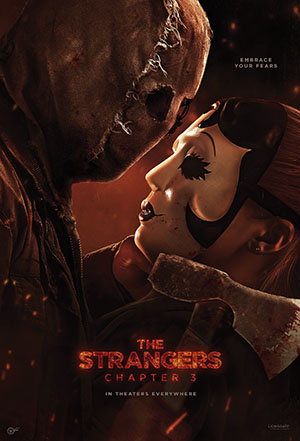
Closing the Circle of Terror: The Strangers: Chapter 3 Film Review
The release of The Strangers: Chapter 3 (2026) marks the culmination of one of the most ambitious experiments in modern horror history. Directed by veteran action and horror filmmaker Renny Harlin, this final installment concludes a trilogy that was filmed back-to-back in the forests of Slovakia. While the previous chapters followed the harrowing survival journey of Maya (Madelaine Petsch), Chapter 3 promises more than just a conclusion; it aims to provide a “full-circle reckoning” for a franchise that has lived in the shadows of its 2008 predecessor for nearly two decades.
In a cinematic landscape often dominated by supernatural entities and complex multiverses, The Strangers: Chapter 3 remains tethered to the grounded, nihilistic terror of human cruelty. This review delves into whether the trilogy’s finale justifies its grand scale or falls victim to the repetitive tropes that have polarized audiences since Chapter 1 debuted in 2024.
Movie Overview
| Feature | Details |
| Title | The Strangers: Chapter 3 |
| Release Date | February 6, 2026 |
| Director | Renny Harlin |
| Lead Cast | Madelaine Petsch, Gabriel Basso, Richard Brake |
| Genre | Horror / Slasher / Thriller |
| Runtime | 91 Minutes |
| Production | Lionsgate |
Full Plot Synopsis
Picking up immediately after the cliffhanger events of Chapter 2, The Strangers: Chapter 3 finds a battered and psychologically fractured Maya (Madelaine Petsch) pushed to her absolute limit. After surviving the initial home invasion and the subsequent pursuit through the woods and small-town traps, Maya is no longer the passive victim seen in the trilogy’s opening.
The story centers on a final, unavoidable collision course between Maya and the trio of masked killers: Scarecrow, Dollface, and Pin-Up Girl. While the previous films focused on the “why” (or lack thereof), Chapter 3 expands the scope, bringing Maya into contact with remnants of the local community who may or may not be complicit in the Strangers’ reign of terror.
As Maya retreats into the densest parts of the woods, she begins to utilize the environment against her attackers. The hunters become the hunted in a series of brutal skirmishes. The film explores the “full-circle” nature of the violence, eventually leading Maya back to the cabin where the nightmare began. The finale focuses on unmasking—not necessarily the physical faces of the killers, but the true nature of their obsession with Maya, culminating in a violent showdown that determines if anyone can truly survive a run-in with the Strangers.
Detailed Critique and Analysis
Themes: Nihilism vs. Evolution
The primary theme of The Strangers has always been “randomness.” However, Chapter 3 attempts to evolve this by examining the psychological toll of prolonged trauma. Harlin explores how a victim’s humanity is stripped away when forced to mirror the brutality of their attackers. While the original 2008 film was celebrated for its lack of motive, Chapter 3 flirts with giving the killers more “purpose,” which may satisfy those seeking closure but risk alienating fans of the series’ signature nihilism.
Acting: Madelaine Petsch’s Survivalist Turn
Madelaine Petsch carries the weight of the entire trilogy on her shoulders. In Chapter 3, her performance shifts from the high-pitched screams of a “Final Girl” to a more stoic, hardened survivor. Her physical acting is commendable; she conveys exhaustion and desperation with every breath. Richard Brake, as Sheriff Rotter, provides a menacing, grounded presence that adds a layer of “folk horror” to the slasher proceedings.
Direction and Visuals
Renny Harlin, known for Die Hard 2 and Deep Blue Sea, brings a polished, kinetic energy to the film. The cinematography by José David Montero makes excellent use of the Slovakian wilderness, transforming it into a claustrophobic maze of shadows. The lighting is notably improved from Chapter 2, opting for deep blacks and stark moonlight that heighten the tension. However, Harlin occasionally leans too heavily on jump scares, which can undercut the atmospheric dread he works so hard to build.
Sound and Screenplay
The sound design is a standout feature. The scraping of the Scarecrow’s axe and the distorted record players create an auditory landscape that is genuinely unsettling. The screenplay, penned by Alan R. Cohen and Alan Freedland, is lean on dialogue, which serves the film’s tension well. The script focuses on action and environmental storytelling, though some of the logic leaps required for the “survivalist” traps Maya sets feel slightly out of character for someone so recently traumatized.
Strengths & Weaknesses
Strengths
-
Stellar Lead Performance: Madelaine Petsch delivers a career-defining turn as Maya.
-
Atmospheric Tension: The use of sound and light creates a persistent sense of unease.
-
Brutal Practical Effects: The kills are visceral and avoid the “clean” look of many modern horror films.
-
Narrative Continuity: Being filmed back-to-back ensures a seamless transition from the previous chapters.
Weaknesses
-
Formulaic Pacing: Despite being a “finale,” many sequences feel like retreads of earlier invasion tropes.
-
Character Logic: Some secondary characters make decisions that serve the plot rather than common sense.
-
Lore Expansion: Attempts to explain the Strangers’ origins may lose the “fear of the unknown” that made the original a cult classic.
Final Verdict
The Strangers: Chapter 3 is a competent, high-intensity conclusion to Renny Harlin’s ambitious trilogy. While it doesn’t quite capture the lightning-in-a-bottle simplicity of Bryan Bertino’s 2008 original, it offers a more satisfying emotional arc for its protagonist than most slasher sequels. It is a film for the “completionists”—those who have followed Maya’s journey through the first two chapters and want to see the masks finally come off. For casual horror fans, it provides a masterclass in tension and practical gore, even if it struggles to break new ground in the home-invasion genre.