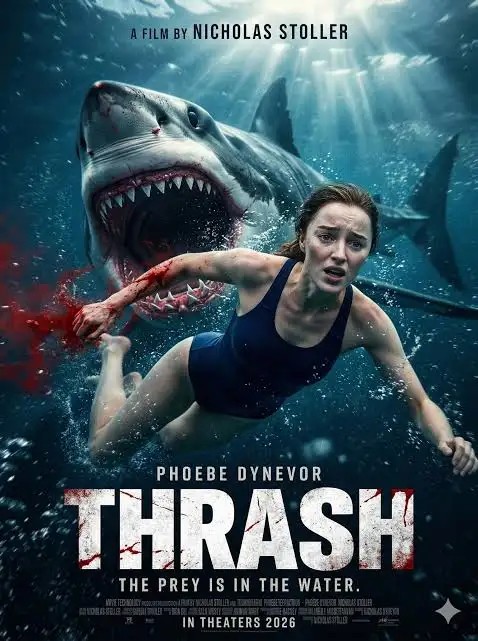
Thrash (2026) Review: Tommy Wirkola’s Shark-Infested Hurricane Thriller Bites Into Netflix
The “shark-in-a-disaster” subgenre has long been a playground for filmmakers looking to marry high-concept spectacle with primal survival instincts. From the cult absurdity of Sharknado to the polished suspense of Crawl, the formula remains a staple of summer—and now, streaming—entertainment. Enter Thrash (2026), the latest offering from Netflix, directed by genre maverick Tommy Wirkola and produced by Academy Award winner Adam McKay.
Released on April 10, 2026, Thrash attempts to pivot away from the campiness typically associated with its premise, aiming instead for a gritty, climate-conscious survival tale. While it successfully delivers heart-pounding sequences and a standout performance from Phoebe Dynevor, the film’s uneven tone and reliance on genre tropes prevent it from reaching the heights of its predecessors.
Film Overview and Key Data
| Feature | Details |
| Title | Thrash |
| Release Date | April 10, 2026 |
| Director | Tommy Wirkola |
| Cast | Phoebe Dynevor, Whitney Peak, Djimon Hounsou |
| Genre | Survival Thriller / Horror / Disaster |
| Runtime | 86 Minutes |
| Production Co. | Hyperobject Industries, Sony Pictures |
| Platform | Netflix |
Full Plot Synopsis: Nature’s Vicious Convergence
The narrative is set in the sleepy coastal town of Annieville, South Carolina, as it braces for the arrival of Hurricane Henry. Meteorologists warn that while Henry is technically a Category 5 storm, the rapid intensification fueled by rising sea temperatures makes it feel like a “Category 6.”
The story follows three intersecting paths. Lisa Fields (Phoebe Dynevor), a heavily pregnant woman who has recently been abandoned by her fiancé, finds herself trapped in town after her evacuation route is cut off by rising waters. Simultaneously, Dakota (Whitney Peak), a young woman struggling with severe agoraphobia following the death of her parents, is paralyzed with fear inside her family home as the storm surge begins to breach the sea wall.
As the levees fail, the town is submerged within minutes. The disaster takes a predatory turn when a tanker truck carrying animal blood is destroyed, its contents spilling into the murky floodwaters. This “chumming” of the downtown area attracts a swarm of aggressive bull sharks and a massive, tagged Great White named Nellie.
Dakota manages to overcome her panic to rescue Lisa from her submerged vehicle, and the two take refuge in Dakota’s dissolving house. Meanwhile, Dakota’s uncle, Dr. Dale Edwards (Djimon Hounsou), a marine biologist, enlists a desperate TV news crew to help him navigate the flooded ruins in a small boat to save his niece. The climax reaches a fever pitch as the floodwaters rise to the rafters, forcing a heavily laboring Lisa to fight for her life—and her newborn’s—against the predators circling below the floorboards.
Detailed Critique: Blood in the Water
Direction and Visuals
Tommy Wirkola, known for the darkly comedic Violent Night and Dead Snow, brings a visceral energy to Thrash. He excels at “contained” horror, utilizing the rising water levels to create a ticking-clock mechanism that feels genuinely oppressive. The production design by David Ingram is arguably the film’s strongest asset; the interlocking sets—where entire floors were removed to simulate rising floods—provide a sense of physical reality that CGI often fails to capture.
Cinematographer Matthew Weston uses overhead shots and low-angle water photography to emphasize the scale of the disaster, often making the sharks feel like omnipresent shadows rather than just monsters. However, the visual effects for the sharks themselves are inconsistent; while the bull sharks look terrifying in the dark, the daytime sequences occasionally betray the film’s streaming budget.
Acting and Character Development
Phoebe Dynevor delivers a physically demanding performance that anchors the film. Her portrayal of Lisa—navigating the dual trauma of abandonment and imminent childbirth amidst a shark attack—is played with a refreshing lack of vanity. Whitney Peak provides a solid emotional counterpoint as Dakota, though the subplot involving her agoraphobia feels somewhat underdeveloped and serves more as a plot device than a deep character study.
Djimon Hounsou brings his trademark gravitas to the role of Dr. Dale Edwards. While his character is largely tasked with exposition and “shark-splaining” the behavior of the predators, Hounsou’s presence lends the film a much-needed sense of legitimacy.
Screenplay and Themes
Written by Wirkola, the screenplay is lean—perhaps too lean. At 86 minutes, Thrash moves at a breakneck pace, but it sacrifices nuanced dialogue for action. The film touches on climate change and the fragility of aging infrastructure (the “Category 6” dialogue), but these themes are secondary to the survival mechanics. The inclusion of a “villainous” foster father subplot feels like a distraction from the primary threat, adding unnecessary melodrama to an already tense situation.
Strengths and Weaknesses
Strengths
-
Pacing: The film wastes no time, jumping into the action within the first fifteen minutes and never letting up.
-
Practical Effects: The use of flooded sets over green screens adds a layer of immersion that heightens the stakes.
-
Phoebe Dynevor’s Performance: She elevates a traditional “scream queen” role into something more gritty and resilient.
-
Creativity in Horror: The “birthing scene in a flood” is a sequence that will likely become a talking point for genre fans.
Weaknesses
-
Thin Character Writing: Most secondary characters are “shark bait” with little to no interior life.
-
Inconsistent CGI: Some of the shark movements feel weightless, particularly during the high-action climax.
-
Tonal Clashes: The movie occasionally flirts with Wirkola’s signature dark humor, but it often feels at odds with the serious disaster-movie tone established earlier.
Final Verdict
Thrash (2026) is a lean, mean survival machine that knows exactly what its audience wants: tension, teeth, and a race against time. While it doesn’t reinvent the wheel or offer the profound social commentary of producer Adam McKay’s other works, it stands as a high-tier entry in the Netflix “popcorn” library. It is a stressful, occasionally brilliant, but ultimately disposable thriller that succeeds thanks to its lead performances and claustrophobic direction.
Final Score: 6.5/10